



Commtrac Foundations
Paper 03 of 04
Research paper
The Silent Partner Syndrome
Why every sale still pays a queue of middlemen first, and how Commtrac removes it
A Commtrac research paper on retail payment infrastructure. August 2026.
In this paper
Contents
The Silent Partner Syndrome
Abstract
Imagine owning a coffee shop. A customer taps a card, the espresso machine hisses, and the sale is done. Except it is not. Before that money reaches the shop's bank account, an issuing bank takes interchange, a card network takes its assessments, a processor takes its margin, and the remainder sits on someone else's settlement schedule for a day or two, exposed to holds, reserves, and disputes long after the customer left happy. The merchant owns the espresso machine, the lease, the payroll, and the risk. Everyone else gets paid first, in percentages, forever. Almost nobody asks why, because the arrangement is older than everyone working behind the counter.
This paper asks why. It walks the route a card payment actually travels and prices the detour: a record USD 198.25 billion in United States card fees in 2025 against restaurant margins of 2.8 percent and grocery margins below 2 percent, a fee structure that regulators' own cost data shows has no per-ticket justification, and a fraud and chargeback economy, USD 33 billion lost to card fraud globally in 2024, that exists only because the credential is a stealable number. It examines why the challengers changed nothing: Amazon discontinued its palm payment service in 2026 for lack of adoption after binding the palm to a stored card, the networks' own biometric programs bind a palm or a face to a network token and keep the queue intact, and the world's real account to account systems, from Pix to UPI to Interac e-Transfer, still demand an app, a QR dance, or a wallet, and still stop at the door of the physical counter. The rail was never the bottleneck. The counter was.
Finally, we present Commtrac POS: a biometrically authenticated terminal that settles every sale account to account over the domestic real time rail, directly into the bank account the merchant already holds. A customer links a bank once, at any terminal, and is recognized at every terminal, with no card, no app, and no wallet on either side of the counter. There is no card network, no acquirer, and no processor custody in the path, no card number to steal, and no chargeback surface to abuse, and every terminal ships with Commtrac Clearing at no charge, so the sale reaches the back office the moment it initiates. It is metered at two cents per settlement and a flat monthly rate per terminal, with zero percent of the ticket.
The Silent Partner Syndrome
1. The Longest Route Between Two Bank Accounts
1.1 Nine stops for a coffee
Strip the branding away and a retail card payment is a request to move money from one bank account to another. Both accounts sit inside regulated banks. In most developed economies those banks are now connected by a domestic real time rail that can move value between them in seconds. The route a card payment actually takes is another matter.
The tap wakes the terminal. The terminal hands the transaction to a gateway or processor, which forwards it to the merchant's acquiring bank, which routes it into the card network, which locates the customer's issuing bank, which decides whether to approve. The approval retraces the same path back to the terminal, and at that point no money has moved at all. What the merchant holds is a promise. The actual funds are batched at the end of the day, cleared through the network, settled to the acquirer, and passed to the merchant on the processor's schedule, typically one to two business days after the sale, longer over weekends, and later still if the processor's risk engine decides the merchant needs a hold or a rolling reserve.
card route
account to account
Every stop on that route is a business, and every business on it is compensated from the merchant's ticket. The issuer takes interchange. The network takes assessments. The acquirer and processor take their markup. None of them cooked the meal, stocked the shelf, or carried the inventory risk. The account to account version of the same event has one leg: the customer's bank pays the merchant's bank. Everything else in the card route exists because of decisions made when that one leg was impossible.
1.2 What the detour collects
The detour is not cheap, and it is not getting cheaper. United States merchants paid a record USD 198.25 billion in card processing fees in 2025, according to Nilson Report data, up from USD 187.2 billion in 2024 and more than triple the USD 62.1 billion of 2009. Of the 2025 total, USD 157.8 billion came from credit cards alone. The average Visa and Mastercard credit swipe fee reached 2.36 percent of the transaction, up from 2.02 percent in 2010. When CMSPI counted every component a merchant actually pays, interchange plus network fees plus acquirer and processor margin, it put the 2024 total at USD 236.4 billion and the all-in average cost of a Visa or Mastercard credit transaction at 2.91 percent. The Merchants Payments Coalition estimates the arrangement adds more than USD 1,200 a year to the average family's cost of living, priced invisibly into everything.
visa fy2025 net margin
50%+
mastercard fy2025 operating margin
57.6%
The other side of the ledger explains why the arrangement persists. In its 2025 fiscal year Visa reported USD 40.0 billion in net revenue and USD 20.1 billion in net income, a net margin above 50 percent. Mastercard closed its 2025 with USD 32.8 billion in net revenue and an operating margin of 57.6 percent. Few large companies on earth run margins like these, and the product is a route. The card networks do not move money. They move messages about money, and charge a percentage of the money for the message.
Then there is the wait. Card settlement lands on the processor's schedule, not the merchant's, and in the meantime the funds sit in accounts the processor controls. The industry's own user agreements reserve the right to hold merchant funds for extended periods; PayPal's permits holds of up to 180 days and in some cases beyond, terms that drew a class action, later settled, over funds frozen without explanation. The merchant sold the product. The customer paid. The intermediary owns the money until it decides otherwise.
The Silent Partner Syndrome
2. A Bridge Over a Gap That Closed
2.1 The constraints were real
This paper does not argue that card networks were a scam. They were an engineering triumph. In the middle of the last century the problem they took on was genuinely unsolvable by any other means: banks could not talk to each other in real time, a merchant had no way to authenticate a stranger's creditworthiness, a customer could not know or safely use a merchant's account details, settlement between institutions took days by design, and there was no such thing as a consumer-facing bank API because there was no such thing as an API. The card solved all of it at once. A bearer credential in the customer's pocket, a private authorization network above the banks, and a rulebook that allocated liability. Merchants signed because the alternative was cash and paper. The percentage was the price of the only bridge across a real gap.
2.2 The constraints dissolved, the toll did not
Every one of those constraints has since fallen. Domestic real time rails now move money between bank accounts in seconds across most of the developed and developing world; the first paper in this series surveyed them at length. Europe went as far as legislating the property: since January 2025, euro area payment providers must credit instant transfers within ten seconds, around the clock, at no premium over an ordinary transfer. Banks expose APIs. Account ownership can be verified at initiation. Strong customer authentication is a regulatory requirement, not a dream. The engineering gap the card bridged has closed underneath it.
The toll, however, went up. While the average United States credit swipe fee climbed from 2.02 to 2.36 percent, the regulator that actually measured what a transaction costs to process reached the opposite conclusion. The Federal Reserve's cap on regulated debit interchange is 21 cents plus five hundredths of a percent plus a one cent fraud adjustment, a formula that is almost entirely flat because the measured cost is almost entirely flat, and in 2023 the Fed proposed lowering the base to 14.4 cents because issuer costs had kept falling. Actual covered-issuer debit interchange in 2024 averaged 23 cents on a USD 48.95 ticket. The European Union capped consumer interchange at 0.2 percent for debit and 0.3 percent for credit a decade ago, which leaves the average American credit swipe fee nearly eight times the European interchange ceiling, for identical work. Even the European caps leaked: a ten year review found the regulation's effect on merchant costs was temporary and limited, because the networks recovered capped interchange by raising the scheme and processing fees the caps did not cover. Australia's central bank, concluding its own review in March 2026, cut domestic credit interchange from 0.8 to 0.3 percent and ordered the fee structure into the open, after finding that a small merchant on a blended rate pays around 1.4 percent while a large merchant pays 0.6 percent for the same processing.
what regulators measured
what networks bill
The pattern across three continents is the same. Wherever a regulator measures the cost of moving a retail payment, it finds a flat, small number. Wherever the networks price it, it is a percentage that rises with the ticket and falls with the merchant's bargaining power. The percentage is not a cost. It is a position.
2.3 Twenty years in court for a tenth of a point
If relief were coming from within the system, it has had time to arrive. The main United States merchant antitrust case against Visa and Mastercard was filed in 2005. In 2024 a federal judge rejected a proposed settlement whose savings she found inadequate. The replacement, announced in November 2025 and granted preliminary approval in June 2026, is valued at USD 38 billion and its headline term is an average credit interchange reduction of one tenth of a percentage point for five years, plus surcharging freedoms and a partial relaxation of the rule forcing merchants to honor every card. The National Retail Federation's response: the deal "offers no meaningful relief and leaves intact the underlying system that enables Visa and Mastercard to dictate the rules." Objections and appeals are expected to run for years. In parallel, the Credit Card Competition Act, which would merely require a second routing network on credit cards, was reintroduced in January 2026 and remains unpassed.
Two decades of litigation produced a tenth of a point, temporarily. The lesson is not that the fight was pointless. The lesson is that the fee is not the disease. The architecture is, and no settlement negotiates architecture.
The Silent Partner Syndrome
3. The Silent Partner on the Margin
3.1 Restaurants, grocers, forecourts
A percentage of revenue means nothing until it stands next to a margin, so put the two numbers side by side.
The National Restaurant Association reports that the median full service restaurant earned a pre-tax margin of 2.8 percent in 2024, down from 4.0 percent before the pandemic. The all-in cost of accepting the average credit card, per CMSPI, is 2.91 percent of the ticket. On a card-paid dinner, the payment queue's take now exceeds the restaurant's own pre-tax profit on that dinner. The association's 2026 operator survey fills in the texture: card processing is the third largest operating expense in the industry, behind only food and labor, 66 percent of operators say their processing fees rose in the past two years, by an average of 9.4 percent, and the association states flatly that United States swipe fees are the highest in the industrialized world "because just two companies control 80% of the credit card processing market."
Grocery is thinner still. FMI, the food industry association, reports net grocery margins of 1.7 percent in 2024 and 2.1 percent in 2025, with roughly one in ten food retailers operating at a loss. Convenience stores make the arithmetic explicit: NACS reports the industry paid USD 21 billion in swipe fees in 2024, up more than 80 percent since 2020, that card fees are the industry's second highest operating cost after labor, and that "for many in the c-store industry, the swipe fees they pay exceed their pre-tax profits." At the fuel pump, card fees ran 8.4 cents on a gallon whose entire gross margin averaged around 36 cents, roughly a quarter of the margin consumed before rent, wages, or utilities.
A restaurant selling USD 2 million a year across the counter hands the queue roughly USD 58,000 of it at the all-in average rate. At the industry's median margin, that restaurant's entire annual pre-tax profit is about USD 56,000. The queue out-earns the owner. It took no lease, hired no staff, and threw out no spoiled inventory. It is, in the most literal sense available, a silent partner, holding a permanent percentage of the business that no one remembers negotiating.
3.2 The percentage is the product
Defenders of ad valorem pricing must answer a simple question: what about a USD 4,000 transaction costs forty times more to process than a USD 100 transaction? The industry's standard answer is risk: a larger ticket carries a larger fraud and chargeback exposure, so the fee scales with it. Notice what that answer concedes. The exposure exists only because the card model made retail payments reversible, a design choice Section 4 returns to, and the price bears no relation to the risk: global card fraud runs at 6.43 cents per USD 100 of volume, the fraud adjustment in the Federal Reserve's debit cap is a single cent, and the average credit fee is 2.36 percent. Building modern commerce on reversible transactions is one of the root causes of the silent partner syndrome, and charging a percentage to insure against it is how the syndrome is billed. The message is the same size. The authorization takes the same time. The terminal, the network hop, and the settlement entry are identical. The regulators who measured it, as Section 2 showed, priced the work in cents. The networks price it in percentage points because a percentage scales with the economy while a cost does not, and because the fee is extracted upstream of the merchant's attention, inside the statement, where it reads as weather rather than as a decision.
The percentage also compounds in ways a flat fee cannot. It is charged on the sales tax the merchant collects for the state; NACS calculates that of the USD 21.3 billion the convenience industry paid in 2025, USD 4.6 billion was charged on taxes the retailer merely passes through. It falls hardest on the smallest: the same Australian central bank review found small merchants paying more than double the rate of large ones. And it is now visible enough that merchants have begun printing it on the receipt. A third of United States small businesses reported surcharging card payments by late 2024. Surcharging is not a solution; it is a symptom, the queue's cost breaking the surface of consumer prices after decades submerged. Merchants do not pay 2.9 percent. They surrender 2.9 percent of ownership in every sale, permanently, to companies that carry none of the business's risk.
The Silent Partner Syndrome
4. The Credential Is the Crime Scene
4.1 An economy built on a stealable number
The card model has a structural flaw no rule change can fix: the credential is a static number, and the number is the money. To accept it, merchants, gateways, and processors must receive it, transmit it, and frequently store it. Whoever holds the number can spend the account. Everything the industry calls card fraud grows from that single design decision.
The scale is documented by the industry itself. Global card fraud losses reached USD 33.41 billion in 2024 per the Nilson Report, 6.43 cents of every USD 100 of card volume, and the United States, with 26.31 percent of global card volume, absorbed 41.87 percent of global fraud losses. Nilson projects USD 407.6 billion in cumulative card fraud losses through 2034, and that projection assumes the industry's fraud models keep improving. The defense of the number is an industry in its own right: PCI DSS compliance, mandatory for anyone touching card data, costs small businesses thousands of dollars a year and large ones six figures per assessment. It does not stop the bleeding. In September 2024 the payment gateway Slim CD disclosed that card numbers and expiry dates for 1.7 million people had been exposed from its systems, one entry in a decades-long ledger of processors and merchants breached for the numbers they were required to hold. Meanwhile the numbers are hunted industrially: Visa's own risk reporting describes enumeration attacks, automated guessing of valid card number, expiry, and CVV combinations, running at hundreds of millions of suspected attack transactions in a six month window, up 22 percent period over period.
None of this is abuse of the system. It is the system. A credential that must be replicated across every counterparty to function is a credential that leaks by design, and an entire perimeter industry exists to slow the leak. Remove the number and the perimeter has nothing left to defend.
4.2 The chargeback machine
The card's other inheritance is the dispute. Because a card authorization is a promise rather than a settlement, the promise can be revoked, and revoking it has become a consumer habit with its own economy. Mastercard and Datos Insights count 261 million chargebacks globally in 2025, worth USD 33.8 billion, and project 324 million worth USD 41.7 billion by 2028. Issuers spend nine to ten dollars processing each dispute. Surveyed merchants spend USD 100,000 to 500,000 a year on chargeback management technology alone, a budget line that exists to argue with the payment system about sales that already happened. A large and growing share of it is not fraud recovery but fraud itself: Visa attributes roughly 20 percent of fraudulent disputes to so-called friendly fraud, customers disputing legitimate purchases, and up to 30 percent for large online merchants.
Stand back and count what the queue leaves open. The merchant pays a percentage for the route, waits days for settlement, funds the fraud losses priced into interchange, pays for PCI compliance to guard the number, pays again to fight chargebacks, and can still lose the money and the goods months after the sale. The industry sells insurance against a fire the architecture keeps lighting. Card fraud is not a crime wave the industry fights. It is a property of the credential the industry sells.
The Silent Partner Syndrome
5. New Credentials, Same Queue
5.1 The palm that still paid interchange
The obvious response to Section 4 is that the industry knows the plastic is the weakness, and has spent a decade replacing it. It has. What it has not replaced, in a single deployed case, is the queue behind it.
The cleanest cautionary tale is Amazon One. Launched in 2020, it was biometrics at retail done by the company with the deepest retail integration on earth: palm scanners at the door and the till, rolled out to more than 500 Whole Foods stores. Enrollment required a credit or debit card and a phone number, because the palm did not replace the card. It pointed at one. Every wave of the hand triggered an ordinary card transaction on the stored credential, interchange and all; the biometric was a new way to present the same number. The theater was new; the underlying issue went untouched. United States senators publicly questioned the wisdom of uploading palm biometrics to the cloud, customers saw no reason to enroll a body part to do what a tap already did, and by mid 2023 Amazon's own milestone announcement could claim just over three million cumulative uses. For scale, Canada's domestic debit network alone clears roughly nineteen million transactions every day. In January 2026 Amazon announced the end: "In response to limited customer adoption, we're discontinuing Amazon One." Retail service ended June 3, 2026, and the palm data is being deleted.
None of this is offered as mockery of another company's initiative. Amazon ran the experiment the entire industry was watching, and ran it seriously; placing bets and losing some is how a company eventually finds the one that pays.
That being said, Amazon One did not fail because palms are a bad credential. It failed because it changed nothing underneath. The merchant still paid the queue, the customer still carried a card account, and the friction of enrollment bought no new capability for either of them. A biometric bolted onto the card model inherits the card model's economics, and the card model's economics were the problem. The problem and its solution have been staring the industry in the face. Almost nobody is looking from the right angle, and until now nobody has executed the answer.
5.2 The networks' own biometrics
The card networks watched all of this and drew a characteristic conclusion: the palm is worth owning, provided it presents a card. Visa's palm payment pilot with Tencent in Singapore, announced in late 2024, enrolls a customer by having them tap their Visa card and scan their palm, binding the palm to a Visa payment token; the pilot began at a single café with three participating banks. Mastercard's Biometric Checkout Program, launched in 2022, enrolls a face and payment details through a partner app, and a smile at the till releases a tokenized card authorization; four years on, its public footprint is measured in single digit store counts per market. Mastercard's stated ambition for 2030 is checkout with no card numbers and no passwords, achieved through tokenization plus biometrics, which is to say: the number hidden, the network kept. J.P. Morgan, one of the world's largest merchant acquirers, is rolling out palm and face checkout with PopID on the same basis, inheriting the palm use case Amazon abandoned, still settling every scan across card rails.
The engineering is real and the security improvements are genuine. But note precisely what is being built: the biometric authenticates the customer to the token, the token rides the network, the network charges the percentage, and the merchant's statement looks exactly as it did before. Nothing is actually changing. The industry is not removing the middlemen. It is teaching your hand to present their product. Every biometric program the networks have shipped binds the body to a card credential, because the alternative is binding it to a bank account, and no percentage survives that.
5.3 The revolt a card issuer bought
Merchants have tried to storm the queue directly. The definitive attempt was MCX, the consortium Walmart, Target, Best Buy, CVS, and dozens of other United States retailers formed to build CurrentC, a wallet designed to route purchases over ACH and bypass card fees entirely. It chose QR codes just as the market moved to NFC, asked shoppers to open an app and scan barcodes at the till, suffered a breach of tester email addresses before launching, and never expanded beyond a single pilot city. Some members disabled NFC in their stores to block Apple Pay while CurrentC gestated, enraging the very customers the wallet needed. It shut down in 2016, and in 2017 its technology was purchased by JPMorgan Chase. The assets of the merchant revolt ended their journey inside a card issuing bank.
The failures rhyme. Amazon One, the network pilots, and CurrentC all asked the customer to join something, an enrollment, an app, a wallet, and offered in exchange a payment that was, underneath, the same payment. Friction with no removal of the queue is a product with no reason to exist. The lesson is not that checkout cannot change. It is that checkout will not change for a credential that leads back to the same route. And as long as merchants are stuck with the silent partner, the industry will not see a true shift, because the market follows the money. Nothing motivates a merchant to push and adopt a new way of doing things like an offer to cut more than ninety percent of its payment processing fees.
The Silent Partner Syndrome
6. The Rail Was Never the Bottleneck
6.1 The honest scoreboard of account to account
If the queue is escapable, somewhere on earth someone has escaped it. The honest answer is: partially, regionally, and never yet at the physical counter without a device dance or consumer app Shakespeare. The scoreboard deserves respect and precision.
Brazil's Pix is the strongest case on the board: 79.8 billion transactions in 2025, used by around 93 percent of Brazilian adults, bank account to bank account, and it has genuinely reshaped Brazilian commerce. At the physical counter, however, Pix is a phone product: the customer unlocks a handset and scans a QR code, and when contactless Pix finally arrived in February 2025 it shipped exclusively through Google Wallet, because the other handset platforms had not sought central bank authorization. A state-mandated rail still queued at the door of two foreign wallet vendors. India's UPI is the world's volume champion at 23.66 billion transactions in July 2026 alone, and it too is an app-and-QR system, propped up by a zero-fee mandate whose bill has come due: the government's own Department of Financial Services told a parliamentary committee the ecosystem is financially unsustainable without merchant fees, the committee has recommended reintroducing them, and a single bad afternoon in April 2025 saw national success rates fall to roughly half for two hours. China's giants, Alipay and WeChat Pay, are not account to account systems at all but closed wallets that money is loaded into, charging merchants around 0.6 percent, and Tencent's palm payment, live since 2023, authenticates mainland users with real-name-verified WeChat accounts into that same wallet: a new identifier for the old ledger. Europe legislated a ten second instant rail and still has no pan-European way to use it at a shop counter; Wero, the banks' joint wallet, counts fifty million registered users while its in-store QR mode is planned for 2026 and tap to pay for 2027. The United Kingdom's commercial open banking payments launched their first wave in 2025 scoped to utilities and government, with retail explicitly deferred.
Each of these systems proves a piece of the thesis. Pix and UPI prove consumers will abandon cards at national scale when the alternative is cheap and instant. Their friction proves the rest: every one of them requires the customer to have joined something and to perform something, an app, a code, a charged phone, a wallet balance. And at the physical point of sale, where the card networks collect the bulk of their toll, most of the world's account to account volume simply stops.
The pattern is sitting in plain view. The industry has simply never lined these systems up and read them together.
6.2 The question nobody asks at dinner
Canada states the puzzle in its purest form. Interac e-Transfer moved more than 1.6 billion payments between Canadian bank accounts in the latest reported year, 149 million in the record month alone. Canadians pay rent, split dinners, and settle debts account to account as a reflex. And yet no restaurant floor in the country settles its tables natively by e-Transfer, and, more telling, no one wonders why. The same country runs about seven billion transactions a year through Interac's debit card product, at the counter, through the card model. The account to account habit and the point of sale exist side by side in the same population, the same banks, the same phones, and never touch.
The reasons are precise, and none of them is the rail. An e-Transfer is customer-initiated from inside a banking app: the merchant cannot originate a request from a till, and industry integration guides describe the flow frankly as an offline service in which the customer copies payment details into their own bank's interface. The merchant cannot know, at the counter, who paid, which table the money belongs to, or whether the amount is right; nothing stops a diner sending one cent and walking out. The reference field is whatever the customer types. Confirmation arrives as an email, or as a screenshot the second paper in this series showed to be a fraud economy of its own. Refunds are a manual transfer in the dark. Multiply a busy Friday service by that reconciliation and the question answers itself. Canada's purpose-built replacement, the Real-Time Rail, was promised for 2019 and is now scheduled to launch in the fourth quarter of 2026; the country has spent seven years building a faster rail while the rail it already had moved more than a billion and a half transfers a year between accounts. The missing infrastructure was never the rail. It was everything a counter requires that a rail does not provide.
6.3 What a counter actually requires
List them, and the shape of the answer appears. A point of sale needs initiation: the merchant names the amount and the payment starts at the terminal, with the customer authorizing inside their own bank, not typing into it. It needs identity: certainty about who is standing there, without a card to present or an app to open. It needs sealed metadata: the order reference attached by the merchant, carried bank to bank, untouchable by the customer. It needs a known settlement amount on a known rail. It needs clearing certainty: a signal at the moment of sale that the money is real and usable, not a statement line tomorrow. And it needs all of this with zero enrollment cost per merchant: joined once, valid everywhere, or customers will not join at all.
Readers of the first two papers in this series will recognize the list. A verified identity, a chosen rail, a sealed reference, and a known amount are precisely what the Commtrac API establishes at initiation. Certainty at the moment of payment, produced at the source and carried to finality, is precisely what Commtrac Clearing turns into a policy. What remained was to put those properties on a counter, and to replace the card, the app, and the QR code with the one credential every customer carries by default.
The Silent Partner Syndrome
7. Commtrac POS: The Sale Without the Queue
7.1 What happens at the counter
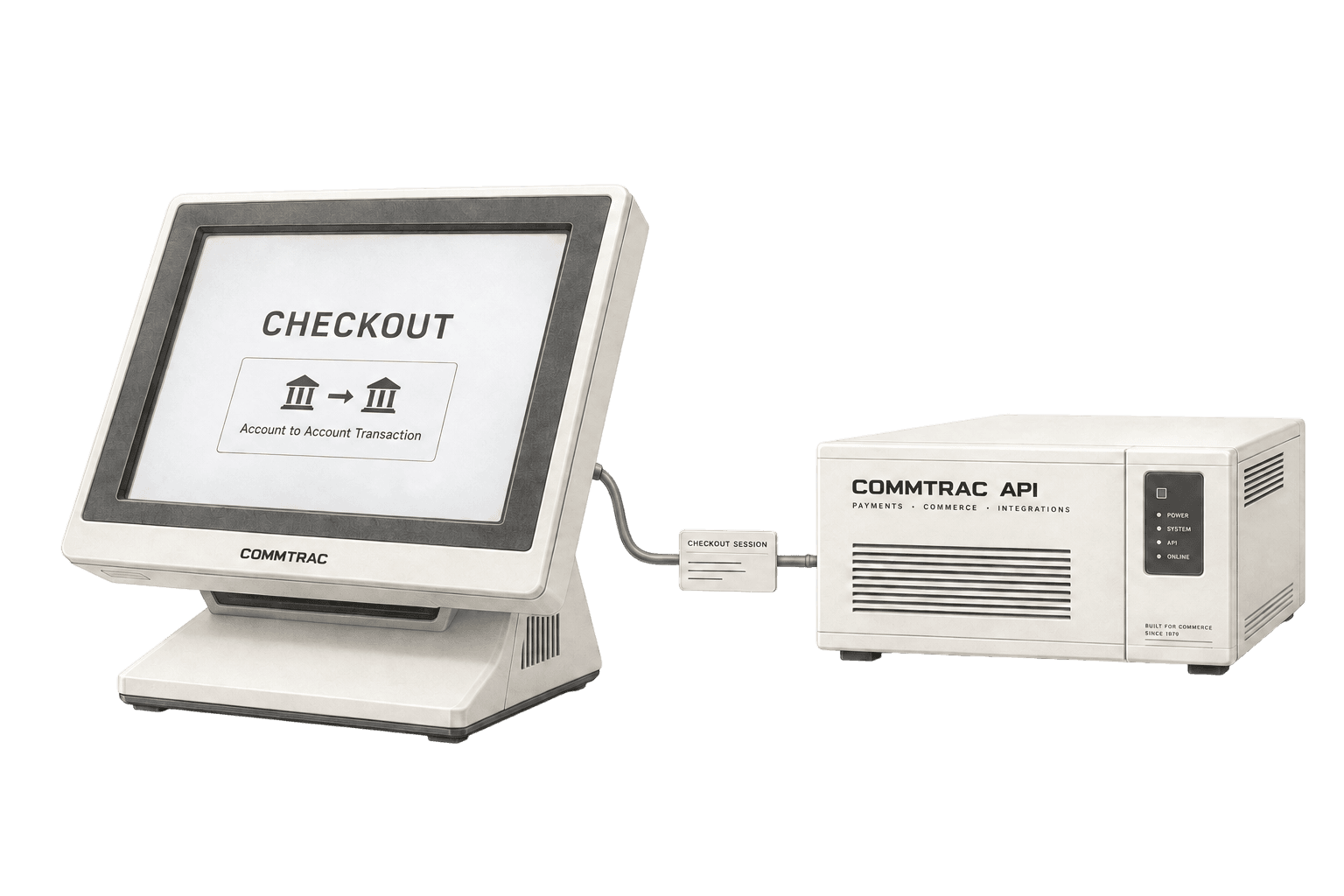
Commtrac POS is a biometrically authenticated countertop terminal that moves a sale from the customer's bank account to the merchant's over the domestic real time rail, account to account, with nothing in between. A customer links their bank once, at any Commtrac POS terminal, by signing in to their own bank; from that moment they are recognized at every Commtrac POS terminal, at any merchant that runs one, with every account they choose to connect. There is nothing to carry, nothing to install, and nothing to re-enroll. No card exists in the transaction. No app exists on either side of the counter.
At the till, the merchant's system names the amount. The customer authenticates with their biometrics and approves. A real time payment, in Canada, for example, an Interac e-Transfer, leaves the account they selected and lands in the merchant's own bank account, the one the business already holds, with the merchant's sealed reference riding inside the payment. Because the rail is irreversible and the initiation is verified, the merchant can treat the sale as cleared the moment it moves, and because every terminal ships with Commtrac Clearing at no charge, the sale reaches order management, CRM, and accounting in the same moment, matched to the table, the order, and the ledger with no human in the path. Where the sale crosses borders, a customer from one country paying at a terminal in another, Commtrac Messaging settles the cross border leg behind the counter, a subject the next paper in this series takes up in full.
Now re-run Section 6's checklist. Initiation at the terminal, authorization inside the customer's own bank. Identity by presence: the payment is authorized by the person standing there, so there is no number to skim, store, phish, or enumerate, and nothing for a Slim CD to leak. Metadata sealed by the merchant, tamper-proof, bank to bank. Amount and rail known at initiation. Clearing certainty by policy, at the second of sale. One enrollment, network wide. And with no card network in the transaction, there is no chargeback mechanism to abuse: the dispute machinery of Section 4.2, the USD 33.8 billion in annual chargebacks, the friendly fraud, the six figure mitigation budgets, has no surface here. A refund becomes what it always should have been, a decision the merchant makes and executes in seconds over the same rail, not a weapon pointed at their settlement account.
7.2 The economics of two cents
Commtrac POS is metered the way Section 2 showed the work actually costs: flat. Two cents per settlement, a flat monthly rate per terminal, and zero percent of the ticket. Two cents on a 40.00 lunch and two cents on a 4,000.00 banquet, with no interchange, no assessments, no processor margin, and no volume tier negotiated over the merchant's head.
Return to the restaurant of Section 3: USD 2 million a year across the counter, USD 58,000 to the queue at the all-in average rate, against a median pre-tax profit near USD 56,000. On Commtrac POS, at an average ticket of fifty dollars, the same volume costs about USD 800 in settlement fees a year, plus a flat terminal rate that does not move with the volume. The 2.8 points the queue no longer takes do not shave a cost line. For a merchant running single digit margins, they roughly double the profit of the business, on the same sales, at the same prices, forever. And the money is not merely cheaper; it is the merchant's, immediately, in the merchant's own account, on no one's payout schedule, subject to no hold and no reserve. No private intermediary should sit in moral judgment over a merchant's own revenue, deciding when it may be spent. On Commtrac POS, none does.
7.3 What is left for the queue
Walk the old route one last time. The card network: not present. The acquirer: not present, because there is no merchant account to hold funds in transit. The processor: not present, the silent partner, gone. That is because there is no batch, no schedule, and no custody. The only party between the two banks is the terminal that initiated the transfer, and it is paid two cents.
The adjacent industry feels it next. The modern point of sale business is, by its own accounting, a payments business wearing a software costume: Toast's 2025 results show USD 5.04 billion of its USD 6.15 billion in revenue coming from payments and fintech, against USD 0.94 billion from the software subscriptions it is named for, a percentage collected on USD 195 billion of merchant card volume. Square raised its card-present rate in 2025 and offered existing sellers relief from the increase only if they maintained a paid software subscription, rails pricing enforcing software sales. When settlement costs two cents, that subsidy runs dry, and point of sale software has to compete as software: inventory, ordering, staff, loyalty, priced at what it is worth, not floated on a percentage of every ticket. The vendors whose products deserve their subscription will keep selling them, on Commtrac POS terminals among other places, through the same back office integrations every terminal ships with. The vendors whose software was a loss leader for a toll will finally have to explain the toll.
The idea that retail finance needs card networks and processors is a facade, but a load-bearing one. Pull them out overnight and commerce would grind to a halt; the dependence is real. It is also operational, not architectural. The infrastructure that makes them unnecessary already exists, standing in plain sight, waiting to be integrated, and until now nobody had seen it whole or executed it properly.
Card networks were never the product. They were a bridge, built across a real gap, by people who solved the hardest payments problem of their century. The gap has been closed for years now: the rails are instant, the banks have doors, identity is provable, and the properties a counter requires can be produced at initiation and carried to finality. What holds the queue in place today is not a law of payments. It is the assumption that it must exist, renewed silently every time a terminal is leased and a statement goes unread. Commtrac POS is that assumption, withdrawn: two bank accounts, a biometric signature, two cents, and nobody else at the table. It was built to expose the silent partner syndrome, and replace it for good.
The Silent Partner Syndrome
Sources
- 01Merchants Payments Coalition, "Credit and Debit Card Swipe Fees Reach Record $198.25 Billion" (Nilson Report data; 2009 and 2010 comparisons; household cost estimate):https://merchantspaymentscoalition.com/credit-and-debit-card-swipe-fees-reach-record-19825-billion-president-and-congress-call-action
- 02Merchants Payments Coalition, "Credit and Debit Card Swipe Fees Totaled $236 Billion in 2024" (CMSPI State of the Industry; 2.91 percent all-in credit cost):https://merchantspaymentscoalition.com/credit-and-debit-card-swipe-fees-totaled-236-billion-2024-over-one-quarter-higher-previously
- 03Stripe, "Payment settlement explained: how it works and how long it takes":https://stripe.com/resources/more/payment-settlement-explained-how-it-works-and-how-long-it-takes
- 04Visa Inc., "Fiscal Fourth Quarter and Full Year 2025 Financial Results":https://investor.visa.com/news/news-details/2025/Visa-Fiscal-Fourth-Quarter-and-Full-Year-2025-Financial-Results/default.aspx
- 05Mastercard Incorporated, "Fourth Quarter and Full Year 2025 Financial Results" (earnings release):https://s25.q4cdn.com/479285134/files/doc_financials/2025/q4/4Q25-Mastercard-Earnings-Release.pdf
- 06Top Class Actions, "PayPal account hold class action settlement" (180 day hold terms):https://topclassactions.com/lawsuit-settlements/closed-settlements/paypal-account-hold-class-action-settlement/
- 07Finextra, "Europe's instant payments regulation and the 9 October deadline explained" (ten second crediting mandate from January 2025):https://www.finextra.com/the-long-read/1471/europes-instant-payments-regulation-and-the-9-october-deadline-explained
- 08Code of Federal Regulations, 12 CFR Part 235 (Regulation II debit interchange standard):https://www.ecfr.gov/current/title-12/chapter-II/subchapter-A/part-235
- 09Federal Reserve Board, "Average debit card interchange fee by payment card network" (Regulation II data):https://www.federalreserve.gov/paymentsystems/regii-average-interchange-fee.htm
- 10Federal Register, "Debit Card Interchange Fees and Routing" (2023 proposal to lower the cap):https://www.federalregister.gov/documents/2023/11/14/2023-24034/debit-card-interchange-fees-and-routing
- 11European Commission, "Antitrust: Commission welcomes European Parliament vote to cap interchange fees" (0.2 and 0.3 percent caps):https://ec.europa.eu/commission/presscorner/detail/en/ip_15_4585
- 12Ecommerce Europe, "The Interchange Fee Regulation turns 10" (temporary and limited effect; scheme fee circumvention):https://ecommerce-europe.eu/news-item/the-interchange-fee-regulation-turns-10/
- 13Reserve Bank of Australia, "Review of Merchant Card Payment Costs and Surcharging: Conclusions Paper" (March 2026; interchange reductions; small versus large merchant cost dispersion):https://www.rba.gov.au/payments-and-infrastructure/review-of-retail-payments-regulation/2026-03/conclusions-paper/pdf/conclusions-paper.pdf
- 14The Daily Record, "Visa, Mastercard $38B swipe fees antitrust settlement" (November 2025 terms):https://thedailyrecord.com/2025/11/10/visa-mastercard-38b-swipe-fees-antitrust-settlement/
- 15American Banker, "Judge approves card network fee settlement with merchants" (June 2026 preliminary approval; National Retail Federation statement):https://www.americanbanker.com/payments/news/judge-approves-card-network-fee-settlement-with-merchants
- 16U.S. Congress, S.3623, Credit Card Competition Act (119th Congress):https://www.congress.gov/bill/119th-congress/senate-bill/3623/text
- 17National Restaurant Association, "Elevated costs continue to pressure restaurant profitability" (median pre-tax margins):https://restaurant.org/research-and-media/research/restaurant-economic-insights/analysis-commentary/elevated-costs-continue-to-pressure-restaurant-profitability/
- 18National Restaurant Association, "What restaurants need to succeed" (operator survey on processing fees; third largest expense; market concentration statement):https://www.restaurant.org/research-and-media/media/press-releases/what-restaurants-need-to-succeed-immigration-reform,-competitive-swipe-fees,-and-strong-trade-polic/
- 19FMI, "The Food Retailing Industry Speaks 2025" (grocery net margins; share of retailers at a loss):https://www.fmi.org/newsroom/latest-news/view/2025/07/15/fmi-report--amid-uncertainty--food-industry-succeeds-in-offering-shoppers-value
- 20NACS, "Credit Card Competition Act" (2024 swipe fee total; fees exceeding pre-tax profits):https://www.convenience.org/advocate-for-the-industry/issues/swipe-fees-and-payments/credit-card-competition-act
- 21NACS, "Swipe Fees and Payments" (second highest operating cost):https://www.convenience.org/advocate-for-the-industry/issues/swipe-fees-and-payments
- 22NACS, "State of the Industry Report of 2025 Data" (2025 swipe fee total; fees charged on collected taxes):https://www.convenience.org/soireport
- 23NACS, "Who Makes Money Selling Gas?" (fuel margins and card fees per gallon):https://www.convenience.org/stay-current/conveniencecorner/who-makes-money-selling-gas
- 24Payments Dive, "Third of US small businesses add credit card surcharges" (J.D. Power survey):https://www.paymentsdive.com/news/third-of-us-small-businesses-add-credit-card-surcharges/739018/
- 25Nilson Report, "Global Card Fraud Losses at $33 Billion" (2024 losses; United States share; ten year projection):https://www.globenewswire.com/news-release/2026/01/07/3214821/0/en/global-card-fraud-losses-at-33-billion.html
- 26SISA, "PCI DSS compliance cost in 2025" (indicative compliance cost ranges):https://sisa.ai/resource/cyberpedia/pci-dss-compliance-cost-in-2025-everything-you-need-to-know
- 27Infosecurity Magazine, "Cyber-attack exposes credit card data of 1.7 million customers" (Slim CD breach):https://www.infosecurity-magazine.com/news/cyber-attack-exposes-credit-card/
- 28Visa, "Payment Ecosystem Risk and Control Report, Spring 2025" (enumeration attack volumes):https://corporate.visa.com/content/dam/VCOM/corporate/solutions/documents/visa-perc-biannual-report-spring-2025.pdf
- 29Mastercard, "What's the true cost of a chargeback in 2025" (Datos Insights chargeback volumes, issuer costs, merchant mitigation spend):https://www.mastercard.com/global/en/news-and-trends/Insights/2025/what-s-the-true-cost-of-a-chargeback-in-2025.html
- 30Visa, "Friendly fraud explained" (first party fraud share of disputes):https://corporate.visa.com/en/solutions/visa-protect/insights/friendly-fraud.html
- 31Amazon, "Amazon One is coming to all 500+ Whole Foods Market stores" (enrollment requirements; cumulative usage milestone):https://www.aboutamazon.com/news/retail/amazon-one-whole-foods-market-palm-scanning
- 32Biometric Update, "Amazon bids farewell to palm biometrics, discontinues Amazon One for retail" (discontinuation statement; end date; data deletion):https://www.biometricupdate.com/202601/amazon-bids-farewell-to-palm-biometrics-discontinues-amazon-one-for-retail
- 33Retail Dive, "Senators raise privacy concerns about Amazon One":https://www.retaildive.com/news/senators-raise-privacy-concerns-about-amazon-one/605058
- 34Tencent, "Tencent and Visa launch palm payment pilot in Singapore" (card-tap enrollment; token binding):https://www.tencent.com/en-us/articles/2201961.html
- 35Mastercard, "With a smile or a wave, paying in store just got personal" (Biometric Checkout Program launch):https://newsroom.mastercard.com/news/press/2022/may/with-a-smile-or-a-wave-paying-in-store-just-got-personal/
- 36Mastercard, "Mastercard champions password-free, number-free checkout across Asia Pacific by 2030":https://www.mastercard.com/news/ap/en/newsroom/press-releases/en/2025/mastercard-champions-password-free-number-free-checkout-across-asia-pacific-by-2030/
- 37J.P. Morgan, "Expanding biometric payments with PopID":https://www.jpmorgan.com/about-us/corporate-news/2024/expanding-biometric-payments-popid
- 38ID Tech, "Amazon discontinues Amazon One palm biometric payment system" (adoption context; acquirer palm rollout plans):https://idtechwire.com/amazon-discontinues-amazon-one-palm-biometric-payment-system-due-to-limited-customer-adoption/
- 39American Banker, "Technology and timing doomed MCX's CurrentC":https://www.americanbanker.com/payments/opinion/technology-and-timing-doomed-mcxs-currentc
- 40PYMNTS, "JPMorgan Chase buys MCX's payments technology":https://www.pymnts.com/news/payment-methods/2017/jpmorgan-chase-buys-mcxs-payments-technology-to-expand-chase-pay/
- 41ClearingPost, "Pix breaks all records in 2025" (transaction volumes; adult adoption):https://clearingpost.com/insights/pix-breaks-all-records-in-2025-798-billion-transactions-move-r-3536-trillion/
- 42Government of Brazil, "Pix por aproximação begins operating" (contactless Pix via Google Wallet, February 2025):https://www.gov.br/secom/pt-br/acompanhe-a-secom/noticias/2025/02/pix-por-aproximacao-comeca-a-funcionar-nesta-sexta-feira-28
- 43Business Standard, "UPI transactions hit record 23.66 billion in July" (July 2026 volumes):https://www.business-standard.com/finance/news/upi-transactions-hit-record-23-66-billion-in-july-value-rs-29-88-trillion-126080100548_1.html
- 44Medianama, "Parliamentary committee calls for return of MDR on UPI" (Department of Financial Services sustainability submission):https://www.medianama.com/2026/03/223-parliamentary-committee-calls-return-mdr-upi-implications-users-small-merchants/
- 45Business Standard, "UPI outages lasted 282 minutes across incidents" (April 2025 outage success rates):https://www.business-standard.com/finance/news/upi-outages-lasted-282-minutes-across-two-incidents-in-2022-2025-125041300574_1.html
- 46Brookings Institution, Aaron Klein, "Is China's new payment system the future?" (wallet model mechanics):https://www.brookings.edu/wp-content/uploads/2019/06/ES_20190620_Klein_ChinaPayments.pdf
- 47Practical Ecommerce, "Digital payments in China are cheap and convenient" (merchant fee levels):https://www.practicalecommerce.com/digital-payments-in-china-are-cheap-and-convenient
- 48South China Morning Post, "Tencent launches palm payments in Beijing" (Weixin Palm Pay account requirements):https://www.scmp.com/tech/big-tech/article/3221377/tencent-launches-palm-payments-beijing-allowing-metro-passengers-pay-wave-hand
- 49European Payments Initiative, "Wero announces first merchants in Germany" (registered users; rollout scope):https://epicompany.eu/media-insights/wero-announces-first-merchants-in-germany/
- 50Banking Vision, "Development of Wero 2025 to 2026" (in-store QR and NFC timelines):https://banking.vision/en/development-wero-2025-2026/
- 51UK Payment Systems Regulator, "cVRP: update on delivery" (Wave 1 scope):https://www.psr.org.uk/media/xgjcblmb/cvrp-update-on-delivery-_-dec-2025.pdf
- 52Interac, "Corporate year in review" (e-Transfer and Interac Debit volumes):https://www.interac.ca/en/company/about/corporate-year-in-review/
- 53Paysafe Developer Documentation, "Interac e-Transfer" (offline, customer-initiated flow):https://developer.paysafe.com/en/api-docs/payments-api/add-payment-methods/interac-e-transfer/
- 54Payments Canada, "Real-Time Rail payment system" (fourth quarter 2026 launch):https://www.payments.ca/systems-services/payment-systems/real-time-rail-payment-system
- 55Finextra, "Canada's real-time payment system won't launch before 2026" (delay chronology):https://www.finextra.com/newsarticle/43993/canadas-real-time-payment-system-wont-launch-before-2026
- 56Toast, "Toast Announces Fourth Quarter and Full Year 2025 Financial Results" (revenue mix; gross payment volume):https://investors.toasttab.com/news/news-details/2026/Toast-Announces-Fourth-Quarter-and-Full-Year-2025-Financial-Results/default.aspx
- 57Square, "Extended card-present rate offer" (2025 rate change; software subscription condition):https://squareup.com/us/en/legal/general/extended-cp-rate-offer-2025
Next step
Put Commtrac to work against your own volumes.
Tell us the rails you run and the institutions your customers bank with. We will walk through what it looks like on your existing stack, and what it costs at your volumes.
Contact sales
Global settlement infrastructure